
The Buyer Is Researching Without You: Is Your Customer Proof Ready?
A potential customer discovers your company through a Google search, a recommendation, a social post, an industry discussion or an AI-generated answer.
They visit your website. But they do not immediately book a demo.
They read your product pages. They check your pricing. They look for companies similar to theirs. They search for implementation details, customer experiences and evidence that your product can deliver what it promises.
They may leave and return several times. They may share your website with a colleague before your sales team even knows they exist. By the time they finally speak to someone from your company, they may already have a strong opinion about your product. This is the reality of the modern B2B buying journey.
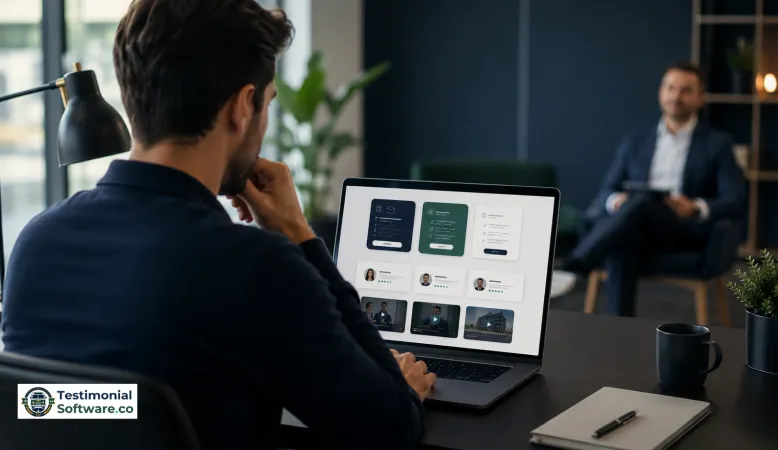
Buyers increasingly want to learn independently before entering a sales conversation. They want the freedom to examine the product, compare alternatives and investigate possible risks in their own time.
Your website is therefore doing more than generating leads.
It is participating in sales conversations that happen without your sales team.
The question is whether your website is merely making claims or helping buyers find credible evidence.
That is where customer proof becomes essential.
Buyers want control before conversation
A buyer researching independently is not necessarily trying to avoid salespeople. They may simply want to understand the product before speaking to one.
A sales conversation requires time and attention. The buyer may need to schedule a meeting, explain their requirements and listen to a presentation before they are certain the solution is relevant.
Independent research feels more efficient.
The buyer can:
- Explore the product at their own pace
- Skip information they already understand
- Compare several options privately
- Prepare questions before a meeting
- Share useful pages with colleagues
- Return later without starting again
- Evaluate the company before revealing their interest
This does not make the salesperson less important.
It changes the point at which sales becomes most valuable.
Instead of introducing basic information that should already be available, the salesperson can focus on the buyer’s specific situation, risks, priorities and internal decision process.
A strong website prepares the buyer for a better sales conversation.
A weak website forces the buyer to contact sales simply to understand the offer.
The information advantage has disappeared
Businesses once controlled most of the information available about their products.
A brochure, presentation or sales representative may have been the buyer’s main source of knowledge. The company decided what the buyer saw and in what order.
That advantage has largely disappeared.
Buyers can now explore product websites, competitor pages, online discussions, demonstration videos, documentation, public reviews and AI-generated comparisons.
Finding information is no longer the main difficulty.
The difficulty is deciding what should be believed.
Every company can describe its product as simple, powerful and reliable.
Every company can publish polished website copy.
Every company can claim to save time, increase revenue or improve productivity.
Modern tools have made professional-looking marketing easier to produce. As a result, presentation quality alone is no longer strong evidence of product quality.
Buyers need something more convincing than the company describing itself.
They need to see what happened when real customers used the product.
Product claims attract attention. Customer evidence creates confidence.
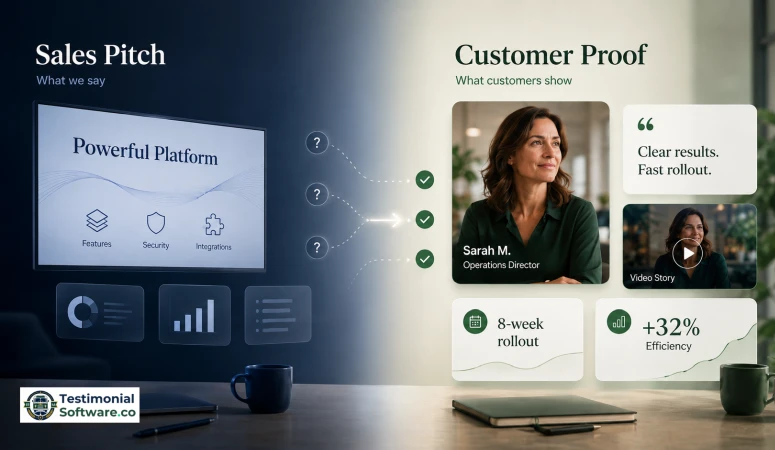
A sales message and a customer story perform different jobs.
A sales message explains the value the company intends to provide.
A customer story shows how that value appeared in a real situation.
For example, a software company may say:
“Bring your customer stories together and help your sales team find relevant proof faster.”
That claim may be clear and useful.
But a buyer may still wonder:
- Was the product easy to implement?
- Did the sales team actually use it?
- How were existing testimonials imported?
- Did customers respond to collection requests?
- Was the system useful after the initial launch?
- Did it reduce work for the marketing team?
A customer experience can answer those questions in a way that the company’s own claim cannot.
The sales message introduces the possibility.
Customer proof makes the possibility believable.
Customer proof is more than praise
Many businesses treat customer proof as a collection of positive comments.
They publish statements such as:
“Excellent product and fantastic support.”
This may create a positive impression, but it offers little help to a serious buyer.
A buyer does not only want to know whether the customer was happy.
They want to understand why the product was useful.
Strong customer proof gives the reader enough detail to learn from the customer’s experience.
It may explain:
- What the customer was trying to solve
- Why the problem mattered
- What they were doing previously
- Why they selected the product
- How they introduced it into their workflow
- What became easier
- What required effort
- What result they experienced
- Who they would recommend it to
Not every testimonial needs to include all of these elements.
A short quotation may support a single product claim. A longer case study may explain the complete journey.
The objective is not to collect the maximum amount of praise.
The objective is to remove uncertainty.
Five qualities that make customer proof useful
Useful customer proof usually contains five qualities: a recognizable source, relevant context, practical experience, a clear change and credible presentation.
1. A recognizable source
The reader should understand who is speaking.
Useful details may include:
- Customer name
- Photograph
- Job title
- Company
- Industry
- Location
- Company size
- Type of customer
These details help the buyer judge whether the story is relevant.
A marketing manager may care more about another marketing manager’s experience than a general quote from an unidentified customer.
Confidentiality may sometimes make full identification impossible. In that case, useful context can still be provided.
For example:
Marketing Director at a mid-sized healthcare software company
This is more informative than:
Verified customer
The reader may not know the person’s name, but they can still understand the perspective behind the statement.
2. Relevant context
A result has little meaning without knowing the situation in which it occurred.
Consider this statement:
“The platform saved our team a great deal of time.”
The buyer still needs to know:
- What work was taking too long?
- How was it previously completed?
- Which team was involved?
- How frequently did the task occur?
- What type of business was using the product?
Context allows the reader to compare the customer’s situation with their own.
The closer the similarity, the more useful the story becomes.
3. Practical experience
Buyers want to understand what using the product was actually like.
This may include:
- Setup
- Data migration
- Training
- Integrations
- Customer support
- Team adoption
- Daily workflow
- Ongoing maintenance
Many customer stories jump directly from the problem to the positive result.
They leave out the middle.
The middle is often where the buyer’s biggest concerns exist.
A credible story can acknowledge that implementation required planning, that employees needed time to adjust or that the customer changed part of their internal process.
Honest details do not weaken a customer story.
They make the positive outcome more believable.
4. A clear change
The buyer needs to understand what became different.
Measurable outcomes are useful when reliable figures are available. These may include time saved, leads generated, response rates, content produced or support requests reduced.
However, not every valuable result needs to be numerical.
A customer may describe outcomes such as:
- A more consistent sales process
- Faster access to approved customer stories
- Easier collaboration between sales and marketing
- Less manual follow-up
- Better visibility into customer feedback
- Greater confidence during client presentations
- A simpler experience for customers
The important requirement is specificity.
This statement is vague:
“It made our work easier.”
This statement is more useful:
“Our sales team can now find an approved customer story without asking marketing to search through old presentations.”
The second statement describes a visible operational change.
5. Credible presentation
The way customer proof is presented affects whether buyers trust it.
Credibility may be strengthened through:
- A link to the customer’s company
- A public profile
- A customer-recorded video
- The date of submission
- Clear attribution
- A source link for imported reviews
- A description of how the story was collected
- Transparent editing and approval practices
Verification does not need to dominate the page.
It can appear quietly through source information, customer details and clear attribution.
The goal is to help the buyer trust where the story came from.
Different questions require different forms of proof
One testimonial format cannot answer every buyer concern.
Different types of proof are useful at different moments.
| Customer-proof format | The question it helps answer |
|---|---|
| Short testimonial | Have real customers had a positive experience? |
| Video testimonial | Does this customer appear genuine and confident? |
| Detailed case study | How was a problem like ours solved? |
| Customer results page | What types of changes have customers experienced? |
| Industry-specific proof page | Does this product work in our market? |
| Implementation story | How difficult will adoption be? |
| Feature-specific quotation | Is this particular capability valuable in practice? |
| Customer interview | What was the complete experience like? |
| Sales proof page | What evidence can I share with my colleagues? |
A short quote may be enough to support a feature description.
A larger purchase may require a detailed story covering implementation, adoption, support and business impact.
The format should match the question the buyer is trying to answer.
Place proof where uncertainty appears
Many companies place all their testimonials on one page.
That page may look impressive, but it often operates like an archive rather than part of the buying journey.
Customer proof becomes more effective when it appears close to the question or claim it supports.
On the homepage
Use a small number of strong customer statements to establish immediate credibility.
Avoid filling the homepage with too many quotations. The purpose is to show that real customers use and value the product.
On product pages
Place relevant proof beside the capability being explained.
When describing a video testimonial feature, include a customer experience related to collecting or using video testimonials.
When describing a sales proof page, include a quote from someone who used customer stories during a sales process.
On industry pages
Show stories from businesses that resemble the intended audience.
A consultant may want to see another consultant. A software buyer may want to see a comparable software company.
Relevant proof is often more persuasive than impressive but unrelated proof.
On the pricing page
Use proof that addresses value, package selection and confidence in the purchase.
The pricing page is where interest becomes financial consideration. Customer evidence can help the buyer understand why the product was worth paying for.
During implementation evaluation
Provide customer experiences covering setup, training, data migration, integrations and support.
Buyers often become cautious when they begin thinking about the work required after purchase.
Implementation proof helps turn a general promise into a realistic expectation.
During internal approval
Provide focused pages that buyers can share with managers, finance teams or technical stakeholders.
The internal champion should not need to collect screenshots and quotations from several parts of your website.
Give them one useful resource that helps them explain the decision.
Relevant proof is stronger than famous proof
A testimonial from a large, recognizable company may attract attention.
But the most persuasive story is often from a customer who resembles the buyer.
A small agency may learn more from another agency than from a global corporation.
A healthcare software company may care more about a customer’s experience with privacy, implementation and compliance than about an impressive result from an unrelated industry.
Relevance can come from:
- Industry
- Company size
- Job role
- Use case
- Region
- Business model
- Technical environment
- Stage of growth
- Purchasing concern
- Internal workflow
A general customer page may still be useful.
However, companies serving several audiences should make it easy for visitors to find the stories most closely connected to their situation.
Why many testimonials fail to influence a purchase
A testimonial can be genuine and still be ineffective.
Several common problems reduce its value.
The customer is unidentified
A quotation with no name, role, company or industry gives the buyer no way to judge its relevance.
The language sounds like advertising
Customer comments filled with words such as “revolutionary,” “world-class” and “game-changing” may appear to have been written by the vendor.
Customers usually describe products through practical changes in their work.
The statement contains no context
A positive outcome is difficult to evaluate when the reader does not understand what happened before the product was introduced.
Every story sounds perfect
Real implementations involve decisions, learning and adjustment.
A collection of flawless success stories may appear heavily controlled rather than authentic.
The proof is outdated
Older testimonials may refer to a previous version of the product or a service that has changed.
Displaying dates helps buyers understand whether a customer experience remains relevant.
The proof is separated from the claim
A customer may praise a particular feature, but the quotation is hidden on a general testimonial page.
Placing it beside the relevant feature increases its usefulness.
The story is difficult to share
A buyer should not have to copy quotations into an email or explain an entire webpage to colleagues.
Focused proof pages make customer evidence easier to circulate internally.
Build proof pages around decisions
A customer-proof page should help the buyer make progress.
Before creating one, decide which decision the page is intended to support.
Possible pages include:
- Customer stories for a particular industry
- Experiences from companies of a particular size
- Results related to a specific use case
- Implementation and onboarding experiences
- Stories addressing a common sales objection
- Customer evidence for a specific product
- A page prepared for an important prospect
- Proof supporting a particular service package
A useful proof page can begin with concise outcomes, customer identities and short quotations.
Visitors who want more detail can continue into complete case studies, interviews or videos.
This gives the buyer a fast overview without removing the opportunity for deeper evaluation.
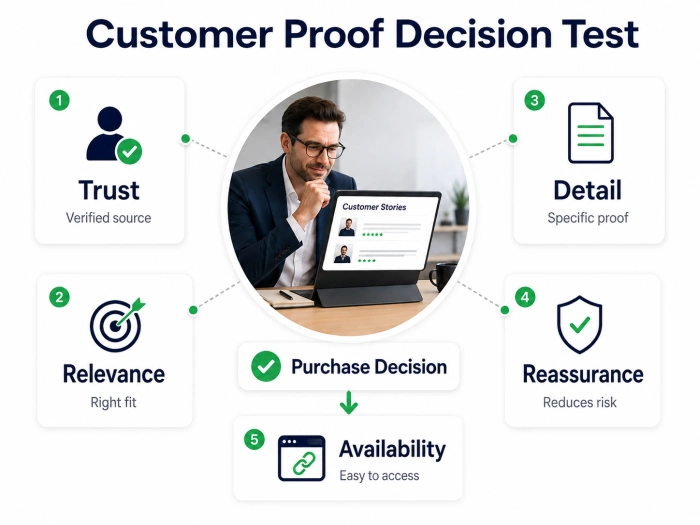
The Customer Proof Decision Test
To make customer proof easier to evaluate, use the following five-part test.
This is an editorial framework created for this article. It is not an external industry standard.
For each area, assess your business from 0 to 20 points.
1. Trust: 20 points
Can the buyer understand who provided the testimonial and why the source should be credible?
Look for:
- Clear attribution
- Customer role
- Company or industry
- Submission date
- Source link
- Video or profile information
- Transparent approval practices
Low score: Anonymous praise with no supporting details.
High score: Clearly attributed customer experiences with enough information to understand the source.
2. Relevance: 20 points
Can buyers find customer stories connected to their situation?
Look for:
- Industry categories
- Use cases
- Company sizes
- Job roles
- Regions
- Common buyer concerns
- Technical environments
Low score: Every visitor sees the same general collection.
High score: Different buyers can quickly find customer experiences that resemble their own needs.
3. Detail: 20 points
Do the stories explain what happened?
Look for:
- The original problem
- Previous workflow
- Reason for choosing the product
- Implementation experience
- How the product was used
- What changed
Low score: General praise with no practical information.
High score: Specific stories that help the buyer understand the customer’s journey.
4. Reassurance: 20 points
Does the proof address concerns that could delay the purchase?
Look for:
- Setup experiences
- Support stories
- Team adoption
- Integration details
- Honest challenges
- Answers to frequent objections
- Realistic expectations
Low score: The proof communicates enthusiasm but does not address risk.
High score: Buyers gain a realistic understanding of both the benefits and the work involved.
5. Availability: 20 points
Can the buyer easily find, read and share the proof?
Look for:
- Placement across important pages
- Search and filtering
- Mobile readability
- Fast page loading
- Dedicated links
- Industry pages
- Sales-friendly proof pages
Low score: Testimonials are buried in one area of the website.
High score: Relevant proof appears throughout the buying process and can be shared easily.
Understanding your result
0–30: Display-only proof
You have customer praise, but it offers limited help during serious evaluation.
31–60: Fragmented proof
Some useful stories exist, but buyers may struggle to find the right ones.
61–80: Decision-supporting proof
Customer evidence answers important questions and supports several stages of the purchase.
81–100: Proof-led buying experience
Customer stories are credible, relevant and integrated into the way buyers evaluate the product.
The purpose is not to achieve a perfect score.
The purpose is to identify where buyers are still being asked to trust a claim without enough evidence.
A practical example
Consider a company selling workflow software to logistics businesses.
Its website says:
“Automate operations and improve team productivity.”
The statement introduces the intended value.
But it leaves several unanswered questions.
A buyer may wonder:
- Which processes were automated?
- How difficult was implementation?
- Did employees accept the new workflow?
- Did the product integrate with existing systems?
- How did the company measure improvement?
The vendor could strengthen the claim through several forms of proof.
A short testimonial might say:
“Our dispatch team no longer enters the same shipment information into three different systems.”
A case study could explain the previous process, the first workflow the company automated and how the team introduced the new system.
A video could allow the operations manager to describe the experience naturally.
An implementation story could explain how long setup took, which departments were involved and what training was required.
A sales proof page could bring the most relevant evidence together for another logistics company evaluating the product.
The original claim remains useful.
Customer evidence gives it substance.
Customer proof helps the buyer make the case internally
One of the most important parts of a B2B purchase happens when the vendor is not present.
The person researching the product may need to explain the recommendation to a manager.
The manager may ask finance.
Finance may question the expected value.
A technical team may raise security or implementation concerns.
The original buyer now has to represent the product inside their own company.
A sales presentation designed for a live meeting may not work well in this situation. It may contain too much vendor language or require explanation from the salesperson.
A relevant customer story is easier to carry into an internal discussion.
It provides a simple structure:
- A company like ours had this problem.
- It selected this solution.
- This is how the product was introduced.
- This is what changed.
- This is why the customer considered it valuable.
The buyer is no longer repeating a marketing promise.
They are presenting evidence from another customer.
The salesperson still has an essential role
Independent research does not remove the need for sales.
It creates an opportunity for salespeople to provide more valuable guidance.
A modern salesperson can act as:
A problem investigator
They help the buyer understand the real issue and separate important requirements from less important preferences.
A proof curator
They select the customer stories, product details and technical information most relevant to the account.
A risk interpreter
They explain limitations, implementation choices and possible sources of difficulty.
A stakeholder guide
They help different departments understand how the product will affect their work.
A commercial adviser
They shape the package, pricing and rollout around the buyer’s actual needs.
Sales becomes more valuable when it moves beyond repeating information available on the website.
Customer proof does not replace the salesperson.
It allows the salesperson to begin from a stronger position.
You do not need hundreds of testimonials
Smaller businesses sometimes assume that proof-led marketing requires a large customer base.
It does not.
A small collection of detailed and relevant stories can be more useful than hundreds of generic quotations.
A business can begin with:
- One story explaining the original customer problem
- One story focused on why the customer chose the product
- One implementation or onboarding experience
- One outcome-focused testimonial
- One story addressing a frequent concern
A longer customer interview can also be turned into several useful formats.
It may become:
- A case study
- A short website quotation
- A video clip
- A social post
- An industry-specific story
- A feature-specific testimonial
- A sales proof page
The objective is not to repeat the same praise everywhere.
The objective is to present the most useful part of the customer’s experience in the right place.
Ask customers for experience, not compliments
The quality of customer proof depends heavily on the questions used to collect it.
This question is likely to produce a vague response:
“Can you give us a positive testimonial?”
Better questions invite the customer to describe what happened.
Ask:
- What problem were you trying to solve?
- How were you handling it before?
- Why did you decide to try this product?
- What was the setup experience like?
- Which part of the product became most useful?
- What changed in your day-to-day work?
- Was anything easier than expected?
- What would you tell another business considering it?
- Who do you think would benefit most from the product?
These questions help customers respond in their own language.
The result is usually more natural, specific and credible than a request for praise.
Protect the authenticity of every customer story
Customer proof becomes valuable only when buyers believe it is genuine.
Businesses should therefore handle it carefully.
They should not:
- Invent customer testimonials
- Create fictional customer identities
- Exaggerate customer outcomes
- Attach a person’s name to an unapproved statement
- Remove context that changes the meaning
- Present vendor-written copy as a spontaneous customer comment
- Use AI to manufacture a customer experience
- Continue publishing a testimonial after permission has been withdrawn
Editing a customer’s response for grammar, clarity or length may be appropriate when the customer approves the final version.
Presentation can be improved.
Meaning should not be manufactured.
AI makes authentic customer experience more valuable
AI tools can help buyers discover products, summarize categories and compare possible solutions.
This may help more companies enter the buyer’s initial consideration.
It may also make several competing products appear similar.
Feature descriptions can be summarized.
Marketing claims can be compressed.
Product categories can be compared within seconds.
But buyers still need answers to practical questions:
- Does the product work in a real business?
- Was implementation manageable?
- Did customers continue using it?
- Was support available when needed?
- Was the result meaningful?
- Would someone in a similar situation recommend it?
AI can help a buyer find your product.
Authentic customer experience helps the buyer trust it.
Companies should therefore make customer stories easy for both people and digital systems to understand.
Use clear headings, written transcripts, customer context and dedicated pages.
Do not hide your strongest evidence inside images, presentations or files that are difficult to discover.
How to create a proof-led buying experience
Begin by listing the questions buyers repeatedly ask before purchasing.
Do not begin with the testimonials you already have.
Begin with the doubts the buyer needs to resolve.
These may include:
- Will this work for a company like ours?
- How difficult is setup?
- How quickly can employees learn it?
- What happens if we need support?
- What result can we realistically expect?
- Why did customers choose this product?
- What problems did they face?
- Is the price justified?
- Can we begin with a smaller rollout?
- Will other departments accept it?
Match each question with the strongest available customer evidence.
Then identify where proof is missing.
Collect new customer stories to fill those gaps.
Finally, place the evidence where the question naturally appears during the buying journey.
This turns testimonials from decorative content into practical sales infrastructure.
Conclusion: Your customers can continue the conversation
The modern B2B buyer wants more control over the early stages of a purchase.
They want to understand the product, compare possible solutions and investigate risk before entering a formal sales process.
A clear sales message can attract attention. A useful website can explain the product.But customer proof performs a different role. It shows that the value exists outside the company’s own presentation.
The strongest buying experience does not force customers to choose between independent research and human guidance. It allows both to work together. Marketing makes relevant customer evidence easy to discover.
Sales brings the most useful evidence into the conversation. Customers provide the experience that makes the company’s claims believable.
Your sales team may not be present during every stage of the buyer’s research. Your customers’ stories can be.
Venkat