
Customer Testimonials in the Age of AI Search: Why Real Customer Proof Matters More Than Ever
AI is changing the way people discover businesses.
For years, the typical online buying journey started with a Google search. A potential customer searched for a product or service, opened several websites, compared options and eventually contacted a business.
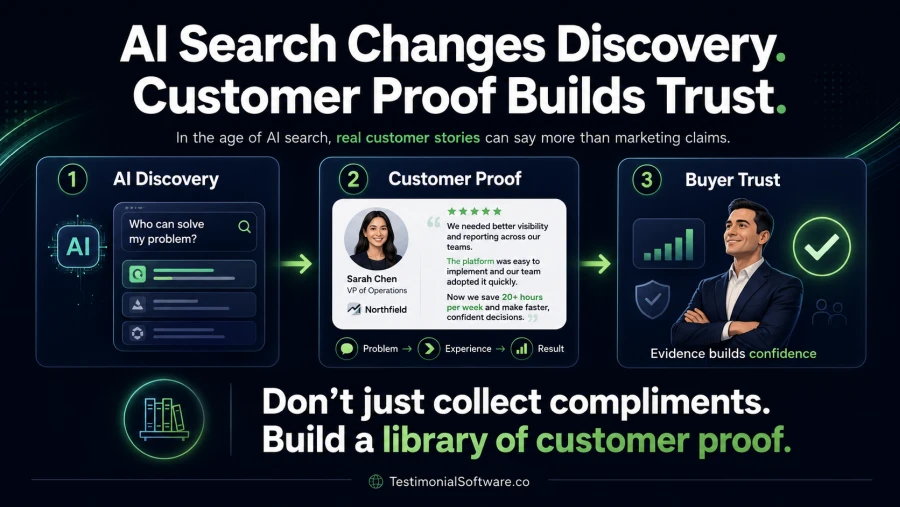
That journey is changing.
Customers can now ask ChatGPT, Gemini, Google AI-powered search experiences and other AI tools questions such as:
- What are the best CRM platforms for a small consulting firm?
- Which HVAC companies serve my area?
- What software can I use to collect video testimonials?
- What should I look for when choosing a financial advisor?
- Which marketing agency is experienced with SaaS companies?
Instead of opening ten websites and assembling an answer themselves, buyers can increasingly receive a summarized answer first.
For businesses, this creates an important question:
When buyers and AI systems are trying to understand your company, what evidence exists beyond what you say about yourself?
That is where customer testimonials, customer stories, case studies and other forms of customer proof become increasingly valuable.
AI Search Is Changing Business Discovery
AI-powered discovery is especially relevant in B2B.
LinkedIn has been researching how AI is changing the buying process and argues that businesses are moving from competing purely for visibility toward competing for what it calls Buyability.
LinkedIn describes customer proof, peer recommendations, expert endorsements and relevance to a specific buying situation as important signals that help buyers feel confident about a company.
LinkedIn has also analyzed how content appears in AI-generated answers. One 2026 analysis looked at 89,000 LinkedIn URLs cited by ChatGPT Search, Google AI Mode and Perplexity, illustrating how seriously marketers are beginning to treat AI-driven discovery alongside traditional search.
This does not mean collecting testimonials will automatically make your company appear in ChatGPT or rank higher in Google.
There is no simple “add testimonials, rank in AI” formula.
But it does point to a broader marketing shift.
Businesses need more credible, specific and publicly accessible information explaining:
Who they help, what problems they solve and what results customers experience.
Your customers can help provide that information.
Your Company Saying It Is Great Is Marketing
Visit almost any business website and you will see claims like:
We provide exceptional customer service.
We are an industry-leading company.
We provide innovative solutions.
We put customers first.
We are a trusted partner.
There is nothing inherently wrong with these statements.
The problem is that almost every competitor can make exactly the same claims.
A business telling people it provides great service is marketing.
A customer explaining why the service was valuable to them is evidence.
Consider these two testimonials.
Testimonial A
Great company. Excellent service. Highly recommended.
It is positive, but it tells a prospective customer very little.
Now consider:
Testimonial B
Our air conditioner stopped working during a particularly hot week. The team inspected the system the same day, explained why repairing our old unit would not make financial sense and installed the replacement two days later. They also showed us how to use the new thermostat and followed up after installation.
Both customers are happy.
But the second testimonial contains much more useful information.
It explains:
- what problem the customer experienced;
- what service they needed;
- how the company responded;
- how quickly the work happened;
- what advice the customer received;
- and what happened after the purchase.
It is valuable to another potential customer because they can recognize their own situation in the story.
That is the difference between a compliment and customer proof.
The Best Testimonials Answer Real Buying Questions
Businesses often collect testimonials by asking one question:
“Can you give us a testimonial?”
The result is frequently something like:
Amazing service!
or:
I would definitely recommend them.
Instead, businesses should help customers tell their story.
Ask questions such as:
What problem were you trying to solve?
This provides context.
A software customer might say:
We were collecting testimonials manually through email and struggling to organize approvals.
A homeowner might say:
Our furnace kept shutting down and the house was not heating evenly.
Why did you choose this company?
This reveals what mattered during the buying decision.
Perhaps it was:
- expertise;
- responsiveness;
- price;
- specialization;
- location;
- recommendations;
- previous experience;
- speed;
- or a particular feature.
What service or product did you use?
Specificity matters.
“Great company” tells very little.
“We hired them to replace our commercial HVAC system” is considerably more useful.
What changed afterward?
This is often the most valuable part of a customer story.
The answer could involve:
- time saved;
- additional revenue;
- lower costs;
- faster project completion;
- better customer service;
- increased leads;
- greater convenience;
- reduced risk;
- or simply peace of mind.
Who would you recommend the business to?
This can reveal the type of customer the company serves particularly well.
Taken together, answers like these can become far more powerful than a one-line five-star quote.
Testimonials Should Be Content, Not Just Decorations
For many websites, testimonials are treated primarily as design elements.
Three customer quotes appear near the bottom of the homepage.
Perhaps another testimonial appears in a slider.
Then they disappear.
There is nothing wrong with testimonial widgets. They can provide valuable reassurance at important points in the buying journey.
But your strongest customer stories deserve to become content assets of their own.
For example, imagine a marketing agency receives a detailed testimonial from a SaaS company.
Instead of displaying only:
They were fantastic to work with.
the agency could create a dedicated customer story containing:
Customer: B2B SaaS company
Challenge: Organic traffic had stopped growing
Service: SEO and content strategy
Approach: Technical fixes, content planning and new landing pages
Outcome: Stronger qualified organic traffic and more demo enquiries
Now a potential SaaS customer can immediately understand that the agency has experience solving a problem similar to theirs.
The same principle works across industries.
An HVAC contractor can publish stories about AC replacements, furnace repairs and commercial maintenance.
A financial advisor can share compliant client experiences around retirement planning or financial organization where regulations permit.
A consultant can publish stories describing specific business challenges.
A photographer can show the finished work alongside the customer’s experience.
A SaaS company can create detailed stories around the problems its software helped customers solve.
The testimonial becomes much more than a quote.
It becomes a useful piece of customer-led content.
Customer Proof Can Help Buyers Defend Their Decision
This matters particularly in B2B sales.
A person evaluating software might love your product, but they may still need approval from a manager, founder, finance department, procurement team or other stakeholders.
Their decision therefore has to be defendable.
LinkedIn and Bain’s recent work on “Buyability” argues that B2B buyers are not simply selecting the solution they personally prefer. Buying groups need confidence in a decision they can collectively support. LinkedIn identifies customer proof and peer recommendations among the signals that contribute to that confidence.
This helps explain why strong customer proof can be so useful in sales.
Imagine two software websites.
Company A says:
Our platform helps agencies improve productivity.
Company B shows:
See how a 14-person marketing agency replaced three manual reporting processes and saved its account managers several hours every week.
For a buyer preparing to recommend software internally, the second piece of information is easier to use.
It provides a story.
It provides context.
It provides a customer similar to them.
And it gives them evidence they can share with somebody else.
Customer Stories Can Support Both Human and AI Discovery
There is an important distinction to make here.
Testimonials are written primarily for people.
You should not turn customer feedback into awkward keyword-stuffed text simply because AI search is becoming important.
Instead, preserve the customer’s authentic experience while providing enough context around it.
A good customer story page might clearly explain:
- who the customer is;
- what industry they operate in;
- what challenge they faced;
- which product or service they purchased;
- how the company helped;
- what outcome followed;
- and what the customer said about the experience.
This creates content that is useful to a prospective buyer.
It also creates clearer information on the public web about the relationships between your company, your services, customer problems and outcomes.
That can make the content easier for search engines and other information-retrieval systems to understand than an isolated quote with no context.
It should be viewed as good content architecture, not an AI-ranking trick.
Don’t Hide All Your Best Proof Inside a Carousel
There is another practical consideration.
Businesses sometimes have dozens of strong testimonials but display only a few inside rotating homepage widgets.
Visitors may never see most of them.
Instead, consider building a central collection of customer proof.
For example:
Website navigation
Home
Services
Industries
Customer Stories
About
Contact
Your Customer Stories section can then contain individual proof pages organized by service, industry or use case.
For a SaaS company, that might look like:
- Customer Stories for Marketing Agencies
- Customer Stories for Consultants
- Customer Stories for Home Service Businesses
- Customer Stories for Financial Advisors
Within those sections, individual stories could address even more specific situations.
This creates something much more valuable than a generic “Wall of Love.”
You are building a library of evidence about the problems your business knows how to solve.
Video Testimonials Add Another Layer of Trust
Written testimonials are valuable because people can quickly scan them.
Video testimonials can add something different.
Prospective customers can see and hear the person describing their experience in their own words.
For businesses where trust matters greatly—consulting, home services, professional services, SaaS, education, financial services, healthcare-related services and other high-consideration purchases—this can be particularly useful.
You do not need every testimonial to be a professionally produced video.
A genuine short customer video answering a few focused questions can often communicate more credibility than an overly polished advertisement.
The key is still the story.
Instead of asking the customer simply to say something nice about your business, encourage them to explain:
Before → Decision → Experience → Result.
That structure naturally produces a useful customer story.
One Customer Story Can Become Several Marketing Assets
Another advantage of collecting detailed customer feedback is that the same story can be repurposed.
One customer interview might become:
- a written testimonial;
- a video testimonial;
- a dedicated proof page;
- a mini case study;
- a homepage quote;
- a website testimonial widget;
- a social media post;
- a sales presentation slide;
- a personalized sales page;
- or supporting material sent to a prospect.
Instead of continually inventing new claims about your company, you can build marketing around the experiences of people who have already purchased from you.
That is a much stronger foundation for trust.
What About Google Reviews and Structured Data?
Public customer reviews can also appear in traditional search environments, but businesses should follow Google’s rules carefully.
Google supports review structured data for certain content types, while also restricting “self-serving” review rich results for organizations and local businesses reviewing themselves.
In other words, businesses should not think of testimonial collection as a shortcut for manufacturing star ratings in Google.
The bigger opportunity is simpler:
Create genuinely useful pages containing authentic customer experiences that help prospective customers make better decisions.
That remains valuable whether a visitor discovers your company through Google, an AI assistant, social media, a recommendation or a sales conversation.
Build a Customer Proof Library Before You Need It
Many businesses wait until they desperately need a case study before asking customers for feedback.
A better approach is to make customer proof part of the normal customer lifecycle.
After a successful project, purchase, implementation or service appointment, ask for feedback.
When a customer gives permission, organize that feedback.
Tag it by:
- industry;
- service;
- product;
- use case;
- customer type;
- location where relevant;
- and problem solved.
Over time, you start building something competitors cannot easily copy.
Competitors can copy your headline.
They can copy your pricing model.
They can build similar features.
They can even imitate parts of your website.
They cannot manufacture your history of successful customer relationships.
That makes customer proof a valuable business asset.
AI May Change Search. Trust Still Drives Decisions.
AI search will continue evolving.
The platforms buyers use today may change.
Search interfaces will change.
Marketing tactics will change.
But the fundamental question buyers ask will remain remarkably familiar:
Can I trust this business to solve my problem?
Your website can answer that question with claims.
Your sales team can answer it with presentations.
Your advertising can repeat the message.
But your customers can provide something different:
proof that somebody had the problem before, chose you and had a positive experience.
That is why testimonials should no longer be treated as a small section near the bottom of a website.
Collect the story.
Add the context.
Organize the proof.
Publish the best stories.
And make it easy for the next potential customer to find evidence that your business can help them.
Turn Customer Stories Into Sales Assets
TestimonialSoftware.co helps businesses collect written and video testimonials and turn customer experiences into useful proof for their websites and sales process.
Instead of leaving your strongest customer stories buried in emails, forms and conversations, you can organize them into testimonials, website widgets, customer proof pages and other reusable sales assets.
Venkat