
LinkedIn has released a new guide for B2B marketers focused on improving brand and content visibility across AI-powered search and answer platforms including ChatGPT, Gemini, Copilot and Perplexity.
Published on August 11, 2026, LinkedIn’s “Unlocking AI Search Visibility: The B2B Marketer’s Guide to LinkedIn by Davang Shah, VP, Marketing at LinkedIn” provides strategies for creating content that can be discovered, understood and cited by AI systems. LinkedIn says the guide brings together strategies, examples, internal testing and findings from its work on AI search over the past 18 months.
AI Is Changing How B2B Buyers Research Companies
LinkedIn argues that AI platforms are increasingly becoming part of the B2B research process, with buyers potentially researching companies and creating shortlists before visiting the companies’ websites.
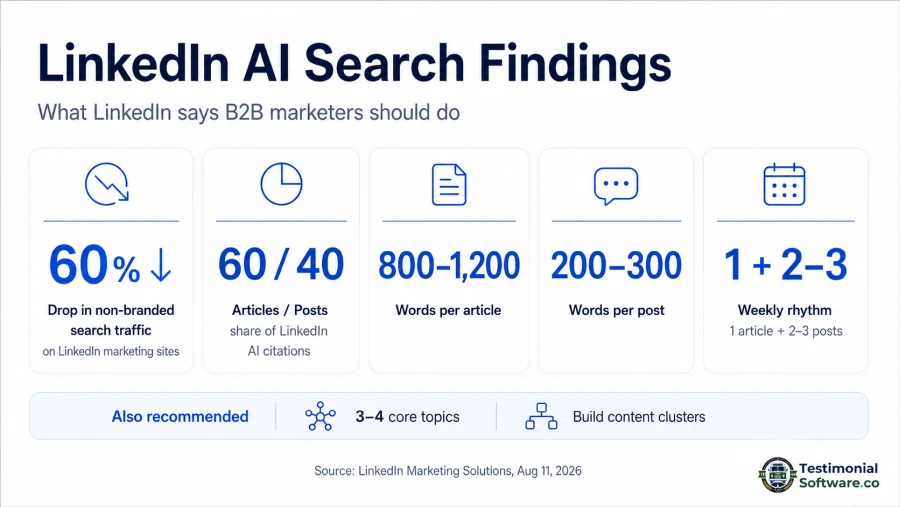
The company cites 6sense research stating that 94% of B2B buyers use generative AI for research. LinkedIn also points to a Gartner prediction that traditional search volume could fall by 50% by 2028. LinkedIn says its own marketing websites have already experienced declines of as much as 60% in non-branded search traffic.
LinkedIn also cites 6sense data showing the average B2B buying cycle fell from 11.3 months in 2024 to 10.1 months in 2025, with faster AI-assisted research contributing to the change.
LinkedIn Positions Its Content as an Important AI Search Signal
One of the main arguments in the new guide is that LinkedIn itself can play an important role in AI search visibility.
LinkedIn cites 2026 research from Profound identifying LinkedIn as the most-cited domain for professional queries in AI search. It also references Meltwater research which found that 75% of LinkedIn citations came from individual member profiles, suggesting that expertise demonstrated by individual professionals can contribute significantly to AI visibility.
For marketers, this means AI search optimization may increasingly extend beyond a company’s website. LinkedIn recommends coordinating company content with executives, employees, subject-matter experts, creators and third-party media coverage so that credible sources reinforce similar themes about a brand.
LinkedIn Recommends Using Both Articles and Posts
LinkedIn’s findings also highlight differences between long-form articles and regular posts.
According to the guide, articles generate roughly 60% of LinkedIn content citations, while posts account for approximately 40%. LinkedIn therefore recommends using both formats as part of an AI visibility strategy.
For long-form LinkedIn articles, the company suggests aiming for around 800 to 1,200 words, using clear section headings and including a short summary near the beginning. For regular posts, LinkedIn recommends approximately 200 to 300 words, focusing each post on one main idea and making the most important information clear early in the post.
LinkedIn also suggests that companies identify three or four important topics they want to be associated with, develop content clusters around those subjects and publish consistently rather than relying on a single article to establish authority.
AI Search May Require New Marketing Metrics
The guide also argues that traditional SEO metrics such as rankings and click-through rates provide only a partial view when users receive information directly inside AI-generated responses.
LinkedIn recommends monitoring measures including AI citations, share of voice, citation position and sentiment, alongside conventional engagement metrics.
Marketers may also need patience when measuring results. LinkedIn cites Profound research showing a median of 6.81 days for new pages to receive citations from ChatGPT or Claude, while 90% of pages can take as long as 37 days. LinkedIn recommends allowing at least 30 days before judging the impact of new AI-search content initiatives.
B2B Content Strategy Expands Beyond Traditional SEO
LinkedIn’s new guide reflects a broader change in digital marketing: brands are increasingly thinking not only about appearing in traditional search results, but also about whether their companies, people and expertise appear in AI-generated answers.
For B2B marketers, LinkedIn’s recommendation is to start with a focused topic, create authoritative long-form content, support it with regular posts and credible expert voices, and then measure whether those signals translate into increased visibility within AI platforms.
Source: LinkedIn Marketing Solutions, “New Guide: How B2B Marketers Can Dominate AI Search on LinkedIn,” published August 11, 2026